
If you’ve searched for HVAC pricing in Palmdale and come away more confused than when you started, you’re not alone. Most cost guides online give you a national average that has nothing to do with our climate, our housing stock, or the actual condition your system is in. So let’s talk about this honestly – what really drives the price of HVAC work here, and how to think about the numbers you’ll see quoted.
The “$5,000 Rule” – What It Actually Means
If you’ve come across the “$5,000 rule” while researching whether to repair or replace your system, here’s what it’s getting at: multiply the age of your unit by the estimated repair cost. If that number comes out above $5,000, replacement is usually the better financial move. A $600 repair on a 4-year-old system (4 × 600 = 2,400) is worth fixing. A $900 repair on a 12-year-old system (12 × 900 = 10,800) is a sign you’re throwing money at a unit that’s near the end of its life anyway.
It’s a useful rule of thumb, not a strict formula – a technician looking at your specific unit will factor in things the math alone can’t, like whether you’ve already had multiple repairs this year, or whether the rest of the system is in good shape. But it’s a fair starting point for the conversation. If you’re at that decision point right now, our air conditioner repair page walks through common repair scenarios, and a technician can tell you honestly which side of the $5,000 rule your situation falls on.
What Actually Drives HVAC Job Cost
There’s no single “average price” that means much, because the range between a small repair and a full system replacement is enormous. What actually determines your cost:
The type of work. A capacitor swap or a refrigerant top-off is a fundamentally different job than replacing a compressor or installing a new system. Pricing scales with the complexity and parts involved, not a flat rate.
System age and accessibility. Older systems sometimes use refrigerant or parts that cost more to source. A unit that’s easy to access costs less to service than one buried behind landscaping or wedged into a tight side-yard, which is common in a lot of Palmdale’s older housing stock.
How urgent the job is. A scheduled tune-up during a normal week costs less than a same-day emergency call during a heat advisory, simply because of how the work gets prioritized and staffed.
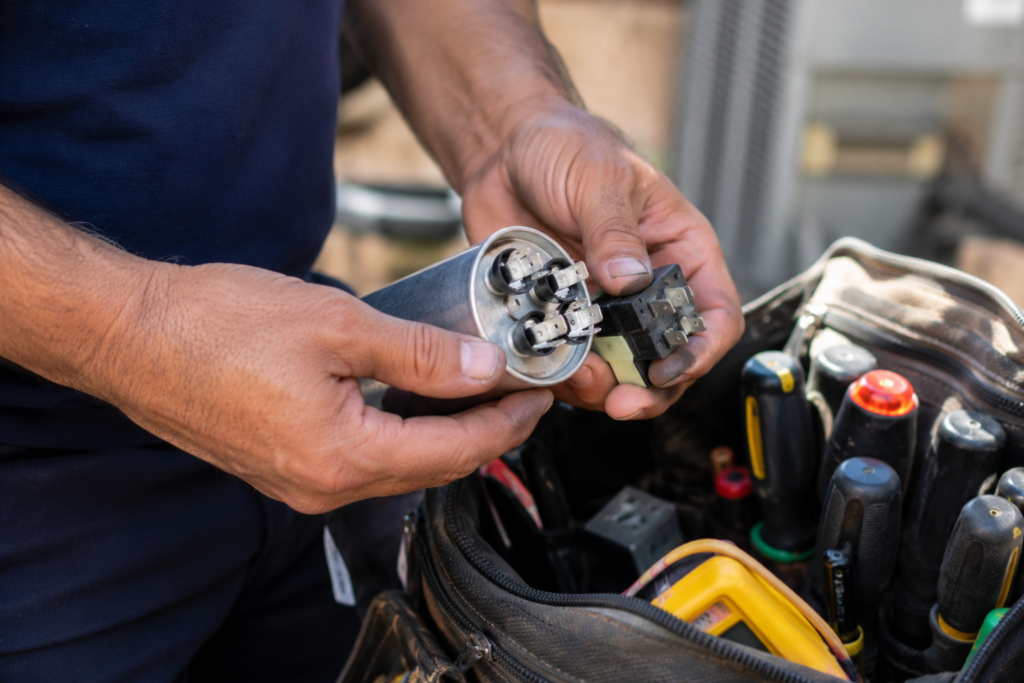
What the diagnosis actually finds. This is the one people find frustrating, but it’s the honest truth – nobody can quote an exact repair price before knowing what’s actually wrong. A technician diagnosing “AC not cooling” might find a $150 capacitor issue or a $1,200 compressor problem. The diagnostic visit is what turns a guess into an actual number.
What a New HVAC System Costs for a Home Like Yours
For a roughly 2,000 sq ft home, sizing matters more than almost anything else in determining cost. A system that’s too small runs constantly and never quite keeps up; one that’s too large cycles on and off too often and wears out faster – neither saves you money. The right size depends on more than square footage: ceiling height, window exposure, insulation quality, and how many rooms the ductwork actually needs to reach all factor in.
This is also where equipment choice matters. Central air, ductless mini-splits, and heat pumps all have different price points and different fits depending on your home’s layout – a mini-split, for example, is often more cost-effective for an addition or a home without existing ductwork than trying to extend central air to it. Our residential AC installation page covers what goes into sizing and choosing the right system, and a proper in-home evaluation is really the only way to get a number that means anything for your specific house.
The Cheapest HVAC Cost Is the One You Never Pay
This sounds like a sales line, but it’s genuinely the most useful piece of cost advice there is: the repairs and replacements that cost the most are almost always the ones that could have been caught earlier. A capacitor that’s starting to weaken is a small fix. The compressor damage that happens because a weak capacitor went unnoticed for a year is not. An AC tune-up once a year is the single best way to keep your costs on the smaller end of the range – it’s a lot cheaper to catch a problem early than to discover it mid-breakdown in July.
Why “Cheap HVAC” Searches Can Backfire
It’s a fair instinct to search for the cheapest option, especially with a big expense like a new system. But in HVAC specifically, the cheapest quote is often cheap because something’s missing – wrong sizing, skipped permits, low-quality parts, or a rushed installation that costs you more in energy bills and early repairs than you saved upfront. The better question to ask a company isn’t “what’s your cheapest price” but “what’s included in this price, and why.” A quote that explains its reasoning is worth more than one that’s just a low number.
Getting an Accurate Number for Your Home
None of the ranges above replace an actual quote, because your home, your system’s condition, and what’s actually wrong are specific to you. The most reliable way to get a real number is a technician looking at your actual system – not a guess based on square footage alone.
Frequently Asked Questions
Is it worth repairing an old AC unit, or should I just replace it?
It depends on the repair cost relative to the unit’s age – the $5,000 rule above is a good starting gut-check. Beyond that, if you’ve had multiple repairs in the past year or two, replacement usually ends up cheaper over time even if the upfront cost is higher.
Why did my quote come back higher than a number I saw online?
Online averages are usually national and don’t account for local labor rates, your system’s specific condition, or the complexity of your home’s setup. A quote based on an actual inspection will always be more accurate than a generic range.
Does a bigger house always mean a more expensive system?
Not necessarily. Insulation quality, window exposure, and ductwork condition can matter as much as square footage. Two homes the same size can need very different systems.
Can a tune-up really lower my long-term costs?
Yes — most of the expensive repairs we see trace back to a smaller issue that went unaddressed for months. Regular maintenance catches those early.
Not sure whether you’re looking at a repair, a tune-up, or a full replacement? Call (661) 543-3885 and we’ll help you figure out which situation you’re actually in before quoting anything. Check our service areas or contact us to schedule an evaluation.
Leave a Reply